
Lately, every business owner I talk to seems to be looking for, or in, a new relationship. It’s intense, it’s moving very fast, and everyone keeps asking when they’re going to make it official. The relationship is with AI, and the pressure isn’t coming from where you’d think.
It’s coming from the conferences, the LinkedIn feeds, the software sales calls, the competitor down the road who swears their chatbot “doubled retail sales.” What it isn’t coming from, as far as I can tell, is the patient.
Think about it as a consumer for a second. When was the last time you rang your bank, your broadband provider, your airline, and thought, I really hope I get to talk to a bot today? Never. Not once. We tap zero. We type “speak to a person” into the chat window like it’s a secret password.
So I couldn’t help but wonder: if the people who matter most to the businesses aren’t asking for AI, why is there so much pressure to say yes to it?
The numbers back up the gut feeling. A Gartner survey of 5,728 customers found that 64% would prefer that companies didn’t use AI for customer service at all, and 53% said they’d consider switching to a competitor if they found out a company was going to. Their number one worry? That it would get harder to reach a human.
Now look at what patients told us in Phorest’s own research, The Modern Patient Experience 2026/27, where we surveyed 795 aesthetics patients across the US, UK and Ireland. 86% enquire to learn more about a treatment. 93% bought a product their clinic recommended. One line from Marion Hand at Florida Lakes Spa that I keep coming back to: “Patients want to feel remembered and valued, not constantly sold to.”
Remembered. Valued. Patients were not asking about when their clinic would have an AI bot to respond 24/7. They said they want to feel known.
The one who takes all the credit
We’ve all dated someone like this. Brilliant at telling the story. Remembers every nice thing they ever did for you, with dates. And somehow, every good thing that happened in the relationship was their idea.
AI is exceptionally good at attribution. That’s genuinely one of its biggest strengths: every message is sent through technology, every click is logged, every booking can be traced back to the text that preceded it. But the AI bot strength exposes a human weakness, and we need to be aware of it.
Let me tell you about a patient. We’ll call her Sarah. Sarah comes in for her consultation. While she’s waiting, she picks up a vitamin C serum from the retail stand and reads the back of it. At the front desk, your receptionist mentions she’s been using it herself for three months, and her skin has never looked better. In the treatment room, the provider looks at Sarah’s skin, talks her through her pigmentation, and says that serum is exactly what she’d recommend alongside the treatment plan. Sarah doesn’t buy it that day. She’s thinking about it.

Two weeks later, an AI agent sends her a lovely, personalised text: “Hi Sarah, based on your recent consultation, you might love our vitamin C serum.” She taps the link and buys it.
Who made that sale?
According to the dashboard, the AI did. Clean, traceable, attributed. According to reality, it was the retail stand, the receptionist’s honest little story, the provider’s clinical expertise, and a reminder at the right moment. The bot showed up for the last thirty seconds of a three-act play and took the bow.
Now scale that up. Imagine you have a team member who makes a big effort to speak about retail. She’s not great at shouting about it. She doesn’t always ring things through under her own name, and she’d never think to send you a weekly summary of her wins. But quietly, through conversation and rapport and genuine recommendation, she’s driving around $2,000 a week in retail.
Then you switch on an AI outreach agent, and your report says it generated $1,500 a week in retail sales. Incredible, right? That’s $1,500 you wouldn’t have had otherwise!
Except it isn’t. If the organic, human-led selling slips because the team assumes “the bot does that now,” you’ve actually just traded $2,000 for $1,500. You’re $500 a week short, and the report is telling you it’s a win. That’s roughly $26,000 a year walking out the door with a smile on its face.
There’s an old line in marketing, usually attributed to the department store pioneer John Wanamaker: “Half the money I spend on advertising is wasted; the trouble is I don’t know which half.” In-person influence has always had this problem. It’s real, it’s powerful, and it’s almost impossible to measure. AI doesn’t fix that. It just makes the measurable half look louder.
The patient report hints at this too. Laser and Skin Clinics, across four locations in Ireland, made a deliberate choice to phone every new lead rather than leave it to email. As Niamh Brunton put it: “The biggest thing with the leads is you need to be willing to sit and have a conversation with them.” And, my favourite: “Out of five, only one might answer, and that’s fine. One is still better than none.” A lead-gen agent might send five beautifully crafted messages and log them all. Niamh’s team is building trust one real conversation at a time. Both show up in the data very differently.
Start in the room, then work backwards
So where does AI belong? Our answer is not to start with the technology. Start with what’s happening on the ground. Start with what happens in the room.
Ask yourself: what experience do I want a patient to have from the moment they enquire to the moment they rebook? Walk the journey. Where does it feel personal? Where does it wobble? Where is my team stretched so thin that they can’t be the warm, expert humans I hired them to be? Then, and only then, ask where AI can support that.
The patient report closes on a line I love: “Technology should protect time for the conversations that need human judgement and care.” That’s the job description. Not replacing the conversation. Protecting it.
Here are two of my favourite examples of what that looks like in real life.
The provider who remembers everything
With Phorest’s Cheat Sheet AI, a provider can glance at a summary of a patient’s previous visits, past treatments and purchases before they walk into the room. So when they say, “How did your skin settle after the peel in March? And are you still loving that SPF?” the patient feels genuinely remembered. Which, if you’ll recall, is exactly what Marion Hand said patients want. The patient experiences a human who cares. The AI simply made sure the human had the notes. Nobody needs to know it was there, and nobody’s experience got worse because of it. That’s the sweet spot.
The rising star nobody had noticed
We had a great example internally where an owner asked Phorest’s AI insights a simple question: “Who is my most up-and-coming team member?” The answer was a provider who would never have appeared at the top of any of the standard reports. She wasn’t the highest earner. She wasn’t top for rebooking. But when you looked at her improvement week over week, she was quietly doing something brilliant compared to where she’d been. That gave the owner a real moment to acknowledge her, to say “I see what you’re doing, keep going,” and to reinforce that behaviour going forward.
Notice what AI did in both of those stories. It didn’t talk to a single patient. It made the people better at being people. It empowered the team. That, to me, is where most clinics should start.
If you do let it talk to patients, date before you commit
There are absolutely places where patient-facing AI makes sense. But if your customers aren’t asking for it, then how you introduce it matters more than whether you do. You wouldn’t move in with someone after one dinner. Same rules apply.
- Test it with a small cohort first. Turn it on for a test group, or run it in test mode with a handful of patients, before you let it loose on your whole book. Read the responses. Does it sound like your clinic? Does it say the right thing when someone asks about downtime, or pricing, or a reaction they’re worried about?
- Respect the people who’ve said no. Some patients have told you, clearly and maybe more than once, that they don’t want to speak to an agent. Believe them. You should be able to switch AI responses off for those individual patients, so they always get a person.
- Keep the human door wide open. Remember Gartner’s finding that the number one fear is not being able to reach a human. Make it easy, obvious and quick.
The noise problem nobody’s talking about
And here’s the thing that keeps me up at night. I could be wrong, but humour me.
If every business starts using AI for outreach and automation, what does our phone look like in a year?
A text from the hair salon: “Your appointment is due!”
One from the clinic: “You’re probably running low on your retinol.”
One from the takeaway: “We haven’t seen you in 4 weeks, here’s 15% off.”
One from the gym, the dentist, the dog groomer. Every one of them perfectly timed and perfectly personalised, and every one of them, collectively, just noise.
We’ve seen this movie before. Email open rates. Banner ads. Push notifications. When everyone does the same clever thing at once, people simply stop noticing. The report already shows the opportunity in getting it right: 75% of patients have received clinic marketing, and 58% booked a treatment after receiving it. That’s a channel worth protecting, not flooding.
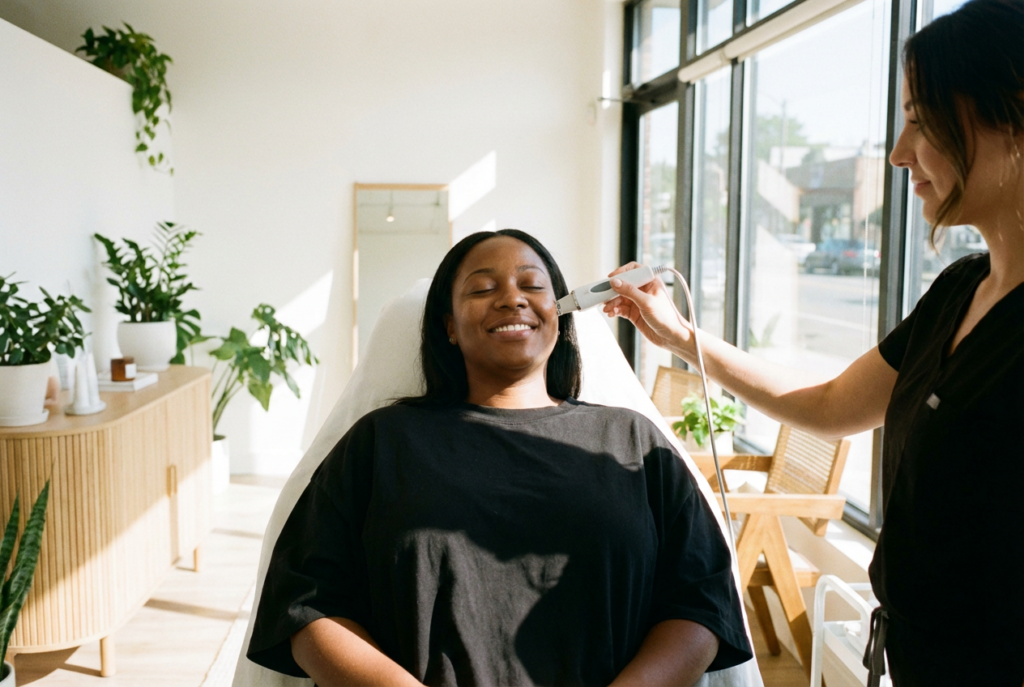
So picture the owner who handed all of their recommendation and follow-up work over to AI, and stopped training their team in it. The day patients become immune to the bot, that outreach quietly stops working. And now the team is out of practice at the very thing that cuts through: a real, personal, genuine recommendation from someone who knows you.
Why this matters even more in a clinic
For medical spas and clinics, this isn’t just a marketing question. At-home skincare in a clinical setting is prescriptive. It’s based on the provider’s training, their assessment of this patient’s skin, their history, and their treatment plan. It has to be individual.
A generic “you might be running low!” text can’t replace a provider saying, “Your barrier is still recovering, so let’s hold off on the acid for another two weeks and stay on the gentle cleanser.” That’s expertise. That’s care. And it’s the reason 93% of patients in our research bought a product their clinic recommended. They trust the person who recommended it.
If we let those skills fade, we don’t just lose retail revenue. We lose the thing that makes a clinic a clinic.
You were fine before you met it
So here’s where I’ve landed. Your business runs well as it is. Your patients come back because of how they feel in your clinic, because of the provider who remembers their wedding date and the receptionist who knows they like the 9 am slot. AI isn’t make-or-break. If you don’t switch on an agent this quarter, your clinic is not going to fall off a cliff.
What AI can be is a brilliant support act. It can help you understand your data, spot the rising star on your team, and make sure your providers walk into every room prepared. Used that way, it makes your people more human, not less.
So before you say yes to the next shiny proposal, ask yourself three questions:
- What experience do I want my patients to have, and where is my team struggling to deliver it?
- Is this AI helping my team show up better, or is it standing in for them?
- If this tool disappeared tomorrow, would my team still know how to do this beautifully?
If you can answer those honestly, you’ll know exactly where AI belongs in your business. And where it doesn’t.
Because in the end, the most important relationship in your clinic isn’t the one with your software. It’s the one with the person sitting in the chair.