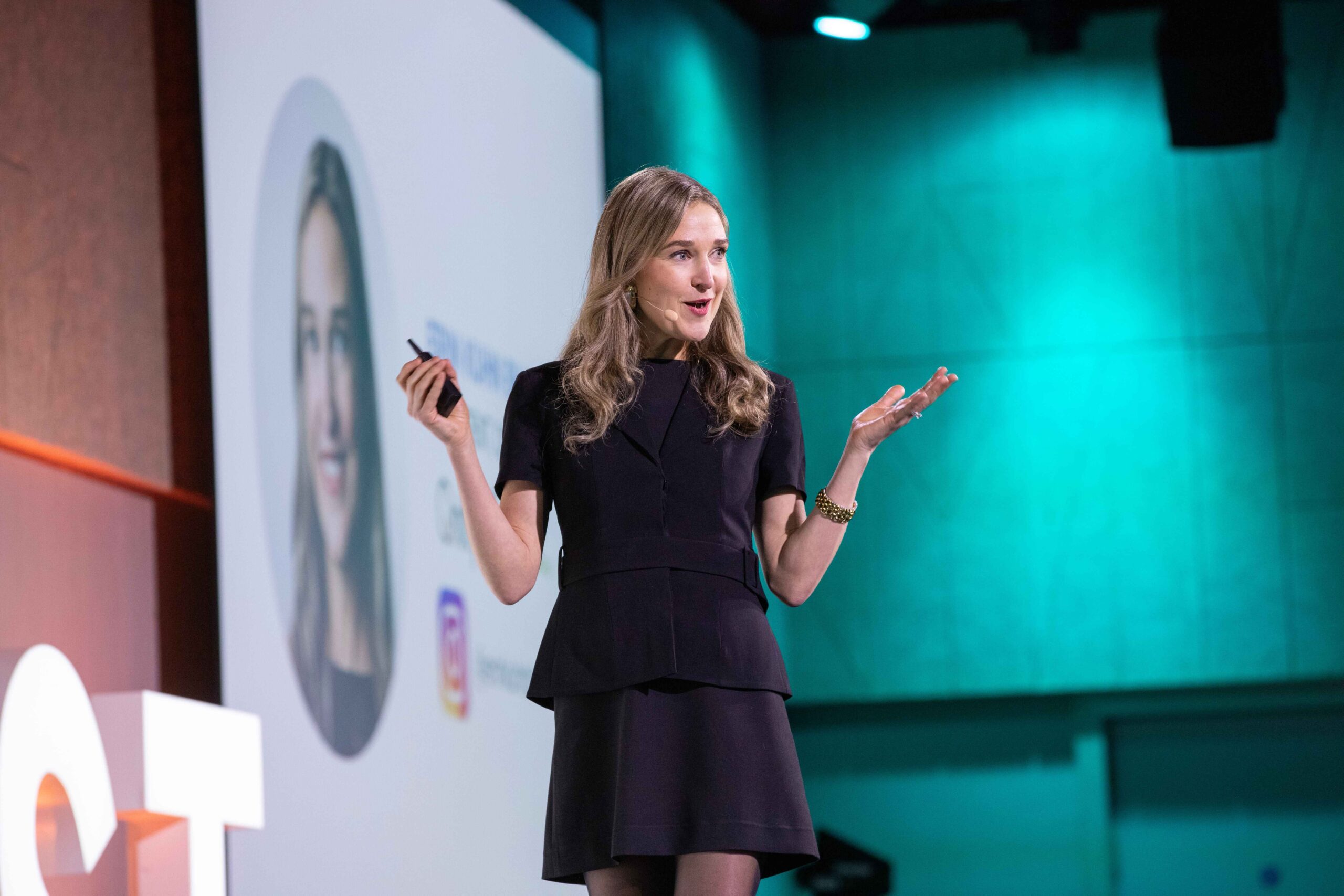

Profit: it’s an uncomfortable topic for many salon, spa, and clinic professionals. Yet, without profit, a business cannot survive. Erin Kuhn Bhansali, President and Partner of Qnity, opened her keynote at the Salon Owners Summit 2026 by addressing that tension head-on. With over 15 years of experience transforming financial education and business performance in the beauty and wellness sector, Erin has helped thousands of professionals build stronger businesses. Her message was clear: profit isn’t about cutting corners. It’s about stability, empowerment, and sustainable growth.
Profitability can be uncomfortable, but it’s non-negotiable
A show of hands confirmed what many in the room already knew: finance isn’t most salon or clinic owners’ favourite part of the job. Erin leaned into this discomfort, grounding her keynote in financial data and case studies from real salons. She highlighted the reality: by nature, salons are low-margin businesses. Qnity’s research shows top performers averaging around 9% profitability, while those at the lower end sit closer to 1%. With margins that tight, there’s very little room for error.
Instead of overwhelming the audience with theory, Erin focused on practical, actionable steps. She brought the data to life, starting with Francie Cawiezell, owner of Hello.Salon in Tulsa, Oklahoma. When Francie first came to Qnity in 2021, she was overwhelmed and operating at 0% profitability. By applying the principles of Qnity’s Profit Playbook, her business grew to 19% profitability, well above the industry average. Her story, along with others shared throughout the keynote, showed what can happen when owners move from avoiding the numbers to actively leading their business through them.
What is profit?
To get grounded before diving into the data, Erin took a moment to define profit in simple terms:
Sales – Expenses = Profit
She was careful to point out that an owner’s salary should be included in expenses. After all, everyone deserves to be paid for the work they do.
Drawing on Qnity’s extensive analysis of salon P&Ls, representing around $600 million in revenue, Erin showed the audience exactly where every dollar goes:
- 58% to labor
- 17% to operating expenses
- 13% on products
- 7% towards space
- 5% is left as profit
The difference between top-performing salons and those at the bottom comes down to everyday actions and behaviors. Erin highlighted that profitability isn’t about cutting costs. While reducing unnecessary spend is effective, the real driver of long-term success is growing the top line: revenue.
Qnity’s Profit Playbook breaks profitability into five core drivers, which owners can take immediate action on:
- Labor
- Products
- Space
- Operating expenses
- Revenue
When managed intentionally, these levers turn small changes into sustainable profit growth.
Labor
As salons, spas, and clinics operate with a human-centered workforce, labor is typically their biggest expense. This can be broken down into service payroll and non-service payroll. Service payroll offers limited opportunities for cuts without risking loss of expertise. Non-service payroll, however, is where owners can optimize, while being mindful of keeping the guest experience intact. Erin pointed to tech-enabled tools like Phorest as a smart way to manage these costs effectively.
A real-world example comes from Taylor Hahn, owner of Bang Salon. When she first came to Qnity, Taylor was struggling so much that she considered laying herself off. By focusing on non-service payroll, Qnity helped her identify opportunities to reduce spending: she spread out stylists to lower assistant hours, cut the social media manager role, and reduced front desk staffing. This resulted in a drop in service payroll by 33%, and non-service payroll fell by 51%. Taylor’s salon went from -25% to +5.7% profitability, adding $25,000 to the bottom line.
Products
Next, Erin touched on product inventory, one of the most misunderstood and poorly managed areas in salons. Inventory costs, she said, should account for shipping, shrinkage, and the impact of heavy discounting, all of which can significantly raise the cost of retail. Top performing businesses control their inventory costs by using spending calculators, applying purchase limits, tracking consistently, and conducting monthly reviews. In Francie Cawiezell’s case, implementing spending thresholds helped eliminate unnecessary discounts and reduce her salon’s cost of retail from 59% to 45%. This was a significant shift that directly improved profitability.
Operating Expenses
Often overlooked, operating expenses are an area many owners should be paying closer attention to. Erin pointed to marketing as an expense that falls under this category that can easily get out of control. Met with knowing nods from the audience, she asked how many had overspent in this area before. Her point was clear: marketing is essential, but it should be managed more strategically.
While some industry benchmarks suggest allocating around 2% of revenue to marketing, Qnity’s findings indicate that closer to 1% is often sufficient when invested wisely.
“Top performing salons are not not spending on marketing, but they’re investing strategically and finding smarter ways to market.”
She highlighted Phorest’s integrated marketing tools as a valuable resource that can significantly maximize return and reduce unnecessary spend in this area.
Space
Recognizing the fact that reducing costs when it comes to your salon, spa, or clinic’s lease is not usually realistic, Erin shared a metric that all owners should be keeping in mind. Revenue per square foot means figuring out how to get smart with your space and your service providers. Qnity’s data shows that top-performing salons generate around $620 per square foot. Erin highlighted how most salons have significant untapped potential for revenue in this area. On average, 71% of salon hours go unsold, meaning only 29% of daily revenue opportunities are being captured.
Laura and Ashley of Tailored Salon experienced this first hand. Their journey with Qnity started in a state of overwhelm. They were unprofitable, both working behind the chair non-stop, and believed their salon to be full. By rethinking their scheduling strategy and space usage, they added eight new team members, increased revenue per square foot, and stepped away from the floor to focus on leadership. Their profitability shifted from -8.5% to +9.7%. This transformation was powerful, but as Erin reminded the audience, it wasn’t instant:
“It’s gradual and then it’s sudden. It doesn’t just happen overnight.”
Revenue
Asking the audience for a show of hands, Erin found that no one felt their business was operating at full revenue potential. She shared that, on average, 71% of opportunities to drive sales in a salon environment are missed every day. The upside to this is revenue is the lever that owners have most control over. Empowering teams to maximize their sales at every opportunity can unlock significant profit growth.
“Driving revenue means maximizing service sales, maximizing retail sales, and maximizing transactions or client count.”
Drawing on her experience working with thousands of students and professionals, Erin emphasized the importance of simplicity. Rather than overwhelming teams with endless metrics, she introduced what Qnity calls the 2 Number Growth Method:
Average ticket x Client count = Total sales
These are the two numbers that drive every business. Erin encouraged the audience to think of them as gas and speed. When working together, they determine how fast and how far your business can grow.
The 17% Growth Challenge
Partnering with Phorest, Qnity is inviting salons, spas, and clinics to take part in their proven 17% Growth Challenge. During the challenge, service providers aim to increase their sales by 17-20% per quarter. Achieving this doesn’t require drastic changes, just a small number of additional clients per week. The impact on both businesses and team culture can be significant over time.
Results from the last challenge show the potential: 51% of participants achieved at least 17% growth, participating salons saw their average ticket rise from $77.32 to $81.53, and each provider earned an additional $17,316 in total sales. Because this challenge is repeatable, these small, intentional steps can lead to major, sustainable results.
In Francie’s case, introducing the 17% Challenge was a key factor in growing her salon to 19% profitability. By running the challenge repeatedly with her team, she boosted culture and engagement while growing total sales by 35% in the first year and a further 20% the following year.
“I wish I could tell you this was a quick fix. I wish I could tell you you could transform profitability overnight. You can’t. It takes time. It’s intentional. It takes focus.”
Launching in April 2026, the challenge comes with a range of incentives to support teams and keep the momentum going:
- Tracker sheets for service providers
- Ongoing education
- Weekly prizes
The grand prize, judged on participation and performance, will include an all-expenses-paid trip to Qnity’s The Fill 2027 in Austin, TX for four team members.
Salon enrollment is open in North America until March 14th 2026.
Money isn’t the only currency
When it comes to building profitability, Erin reminded the audience that money isn’t everything. Time and energy can be just as valuable. Being intentional with all three is what allows salon, spa, and clinic owners to create profitable, sustainable businesses while putting more money into their own pockets and their teams.
For Francie, stepping out from behind the chair was essential. It allowed her to run her business the way she wanted and spend time with her family. Finding that balance had been a key factor in sustaining her profitability.
Ending on a positive, actionable note, Erin encouraged the audience to take what resonated and apply it within their own business. The 17% Growth Challenge is designed to be used by anyone, anywhere. Even if you aren’t participating formally, challenging your team to make small, intentional changes can help increase sales and build long-term growth.